Where’s the Target Audience?
Posted on December 1st, 2008 at 2:34 pm by LashBack Analysts

As I sit here looking at my inbox I wonder why I get Pamper’s, AARP, and Viagra based emails? I am a 37 year old single guy. Is there an email psychic out there that knows that I want these things? I don’t want any of these advertisements. What I do like to see are deals on computer products, health food items, and local events. I like to see messages that are directed toward my personal interests. Not some blind attempt to get my attention. It never works!
How did I get on these lists of annoying mailings? It was my own fault! I bought a phone through a website and hurryingly hit submit before I noticed a box checked allowing partners and affiliates to send me unsolicited email. Read the fine details. I have tried to unsubscribe without success. Now advertisements are sent to me blindly. This all being said, it seems that advertisers and publishers would want their mailings to reach their target audience. It would drive click through sales and increase deliverability. The current system is broken.

~MOE

Canada Lags in Anti-Spam Legislation
Posted on November 17th, 2008 at 3:23 pm by Cari Birkner

According to an article by Carly Weeks of Toronto Globe and Mail, the spam problem in Canada is at an all time high due to government inaction.  In 2005, a federal task force made strong recommendations to the Canadian government to pass anti-spam legislation. In response, back in May, Senator Yoine Goldstein proposed new anti-spam legislation for Canada that closely resembles Australian law, which includes some of the harshest fines for illegal mailers in the world.  However, the bill has yet to be signed into law, as it must be passed in both the Senate and House of Commons.

Meanwhile, Canada is the only G8 country that has yet to pass anti-spam legislation, resulting in reports that spam accounts for nearly 80% of mail in Canadian inboxes. One of Prime Minister Stephen Harper’s campaign promises to protect consumers was to pass anti-spam legislation, and security and privacy experts are eagerly awaiting a follow through.  A lack of regulation on commercial email in Canada not only predicates an increase in fraud and phishing scams that prey on Canadian consumers, but also affects consumers internationally because there is little prosecution authority on Canada-based spammers.

If the aforementioned legislation passes, specifically bill s-235, which is at its second reading stage, reputable email marketers who rely on opt-ins and permission-based lists and follow unsubscribe best practices will not be affected negatively.  Also, certain groups such as charities and political parties would remain exempt. The bill is aimed at sending a strong message to those involved in fraudulent schemes and illegal activity through email and would be a great addition to collective global anti-spam legislation.  Equally important as the legislation is the enforcement behind it.  Any anti-spam legislation passed would need to give the proper amount of authority to enforcement officials and Canadian courts in order to be taken seriously by increasingly bold cyber criminals.

ESPC to Require Suppression File Encryption for Members
Posted on November 16th, 2008 at 12:57 pm by Cari Birkner

As discussed in an earlier post, suppression list abuse continues to plague email marketers who are required by law to share suppression files often.  Previously, many suppression files were sent in a readable, plain text format with only a password to protect the data from abuse.  To cut down on the vulnerabilities that exist when transferring and sending suppression file data, many responsible marketers in the industry have proactively adopted encryption tools such as MD5 hashing technology. 

In an effort to homogenize mailing best practices and protect consumer information, the ESPC board has voted to require all members to use at a minimum, MD5 hash encryption.  Because some mailers may need to make system changes to support file encryption, the deadline for implementation is September 1, 2009.  According to the ESPC statement, members will need to provide ESPC staff with a link to a public statement on their respective company websites indicating their support of this encryption requirement.

LashBack has long championed the use of MD5 hash encryption as a key best practice to eliminate threats associated with suppression list abuse.  Other steps marketers can take to protect the integrity of their data include suppression list cleansing services by UnsubCentral, as well as putting enforceable terms in contracts with their affiliates that spell out the consequences of suppression list abuse.

Unscrupulous marketers mailing to consumers who have specifically opted out of your list can have a negative effect on your company’s reputation.  Leaving un-encrypted data vulnerable to third parties might not only lower your deliverability with ISPs, but also damage consumer perceptions of your brand.  The key to controlling and managing relationships with consumers is building trust.  The only way to build a trusted brand is by monitoring what is being sent to your customers and making it a priority to protect their information.

IAB Issues Email Data Management Best Practices Statement
Posted on November 14th, 2008 at 12:40 pm by James O'Brien

The Interactive Advertising Bureau has issued a position statement that includes privacy and data security guidelines for marketers.  The document, titled Email Data Management Best Practices, emphasizes the importance of sending only to consumers who have opted in to commercial messages.  It also recommends that companies not transfer consumer permission to other companies, giving them the right to mail, without referencing the transfer of permission in the emails of the new company. 

The IAB, in releasing this statement, hopes following these specific email best practices will allow email marketers to increase deliverability, gain the trust of both consumers and advertisers, and encourage responsible actions by all involved in the email ecosystem. LashBack advocates and encourages all who send commercial mail to download this guide to improve best practices and ultimately, performance.

Using Email Intelligence to Increase ROI in an Tough Economy
Posted on November 11th, 2008 at 12:06 pm by James O'Brien

As we enter the fourth quarter, the busiest online shopping season begins and the economy waffles with uncertainty, email marketers will need to use every tool in their lineup to fight for their portion of the holiday consumer dollar. This tough economy means businesses, affiliates and competitors will be pushing the limits to stay competitive.

Last month, LashBack executives attended the eco/LAP Sixth Anual German Anti-Spam Conference in Wiesbaden, Germany, where they learned the implications of increasing cases of fraud and criminal activity in response to a global economic downturn.  In addition, instances of criminals leveraging corporate email infrastructures to send mail both through open relays and secured relays are on the rise once again.

LashBack feels the best way to respond to the recent downturn in the economy is by equipping your email program with intelligence tools that will enhance your competitive edge in the coming months.  That said, there is no time like the present to take full advantage of LashBack’s growing archive of 170,000,000 commercial email messages and constant stream of 3 million messages per day.

Affiliate Loyalty is a service that enables ad networks to see what direct affiliates are sending on their behalf and- for the first time- on behalf of the competition.  By using LashBack’s data, networks are able to learn who is loyal and see which offers are being sent with which networks.

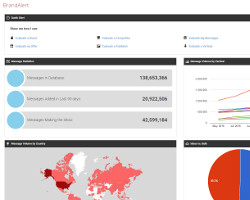
BrandAlert is a service utilized by advertisers and email marketers that is powered by a searchable archive of over 170 million commercial email messages.  BrandAlert can be used both to enforce mailing policies and monitor the sending behavior of third parties, or to monitor the sending behavior of competitors based on search terms or key phrases related to specific products or brands.  For example, using BrandAlert, one LashBack client is able to vet traffic from third parties whom they have not given permission to mail on their behalf.  Other clients use BrandAlert searches to check out the specific email offers and creatives sent by their competitors.

ListMonitor is another intelligence tool which allows list owners and managers to automate seeding of their data directly or smartly seed any data collection website or reg-path with unique seed addresses.  By using ListMonitor, you can see the offers sent to your list for multiple seed addresses in one location to monitor frequency, volume and offer type and ensure your data is not being abused.

Email Law Enforcement Lessons Learned in Germany
Posted on November 6th, 2008 at 6:56 pm by James O'Brien
A photo of Biebrich castle taken by LashBack CEO Brandon Phillips.
A photo of Biebrich Castle taken by LashBack CEO Brandon Phillips.

Last month, LashBack executives attended the eco/LAP 6th Annual German Anti-Spam Summit in Wiesbaden, Germany. At the three-day event held at Biebrich castle, we were able to meet and converse with members of law enforcement agencies representing 146 countries, as well as internet compliance and regulatory consultants like Hein Dries, who owns Vigilo Consult. Attendees and participants included the FTC, ENISA, Hessen-IT, OPTA, Spamhaus and officials from the UK, Germany, Australia, New Zealand and South Korea, among others.

The first day of the conference focused on spam’s latest trends and figures. Highlights included messaging security solutions provider Cloudmark’s presentation with eleven GmbH on the trends and figures of spam, ENISA’s comparison of the existing ISP’s code of conduct in the area of spam, and a presentation by Merijn Schik of the European Commission. The second day featured information on advance fee fraud, lottery spam and the regulatory and preventive actions of law enforcement. A presentation on international law enforcement cooperation included speakers from online divisons of The U.S. Department of Justice, The U.S. Postal Inspection Service, the Amsterdam Police, the Belgian Federal Computer Crime Unit, and OPTA.

LashBack executives learned the latest trends in email security and a new perspective on online crime from several international regulatory bodies. LashBack CEO Brandon Phillips stated, “In Weisbaden, we were able to gain new insights into how investigators go about prosecuting email-based crime in the real world. We found the general consensus from these key international law enforcement bodies is, due to a downturn in the economy, cases of online fraud and criminal activity are on the rise.”

The increase in illegal activity has come in the form of criminals reviving the practice of leveraging corporate email infrastructures to send mail through open relays and even some secured relays. As the economy tightens up, responsible email marketers must be ever vigilant when it comes to the overall compliance of their mailing program- this means keeping a close eye on sending reputation and protecting the integrity of your brand. But more on that next time…

Best Practices: Fighting Suppression List Abuse, Part Two
Posted on October 23rd, 2008 at 12:30 pm by James O'Brien

In addition to using encryption tools, implementing and enforcing policies against suppression list abuse are important tools in a compliant marketer’s arsenal. One such example of setting guidelines and consequences for suppression list abuse comes from LashBack client PMA Media Group and their preferred partner OfferAlliance who have recently added a section to their Terms & Conditions agreement regarding suppression abuse which reads as follows:

11. Suppression Abuse
11.1 Any publisher found taking PMA Media Group’s suppression file, or that of PMA Media Group’s advertisers, will be fined $250 for each suppressed email address mailed to, will forfeit commissions, and/or have their publisher account deactivated.
Suppression abuse will not be tolerated.

We applaud PMA for taking the steps to vet affiliates and encouraging an environment of collaborative compliance between advertisers and publishers. Requiring affiliates to operate under a clear, written contract, monitoring sending behavior, rewarding performance and penalizing defectors are all integral steps marketers must take in order to prevent their suppression lists from being abused. By including stiff fines for suppression list abuse in their Terms, PMA is taking steps to proactively monitor and resolve issues in their email program. The FTC expressly mandates that mailers work to “monitor and resolve issues”, and PMA’s addition of terms is the right move for marketers and a fine example of what practicing collaborative compliance should include.

Click here to read Part One of Fighting Suppression List Abuse.

Best Practices: Fighting Suppression List Abuse
Posted on October 22nd, 2008 at 11:53 am by James O'Brien

In recent months, challenges have arisen for marketers who are working feverishly to protect the integrity of their suppression files. When the FTC passed the CAN-SPAM Act, requiring mailers to share suppression files, many files were passed between advertisers and affiliates in plain text. While it is certainly a best practice for publishers to scrub a send file against an advertiser’s list, files in plain text format can quickly become targets of suppression list abuse. Sharing suppression files without any sort of encryption technology implementation places marketers in a vulnerable position.

Encryption technology such as MD5 hashing has evolved as a way to protect the consumer data contained in email suppression files. Encrypting suppression file data has also become a commonplace best practice for marketers interested in complying with email laws and protecting their brand reputation and valuable consumer data. After all, one of the easier ways to find your name on an ISP’s blacklist is by having your brand or company associated with mailing to a suppression file. The good news is, there are effective, feasible tools for securing consumer data and managing suppression lists. LashBack recommends using UnsubCentral’s solutions for suppression list management and distribution.

Protecting suppression files has never been a more pressing issue, as concerns about consumer privacy increase and the definition of personal identity information or PII broadens. In the near future, MD5 hash and encryption could very well become mandatory rather than simply best practices. The FTC is beginning to view the privacy of consumer email data in the same way it views credit card numbers and social security information, and will likely require it to be protected in the same manner.

Part Two of this post coming soon…

Gateway Interactive Marketing Association Email Event
Posted on October 14th, 2008 at 4:05 pm by James O'Brien

LashBack will be sponsoring this month’s Gateway Interactive Marketing Association event at the Monarch Restaurant in Maplewood. The topic will be E-mail Marketing- The What, Why, How, When You Should Send an Email.

Expert panelists will be discussing be speaking about all aspects of email marketing programs, including testing, reporting, segmenting, demo data, and CAN-SPAM. A panelist from LashBack will discuss how to protect email reputation and improve deliverability through email compliance and best practices. Hope to see you there!

When:
Wednesday, October 15, 6-9 p.m.
6-7 Networking - Eats and Drinks
7-8 Presentation
8-9 More Networking

Where:
Monarch Restaurant
7401 Manchester Rd.
Maplewood, MO 63143

LashBack to Host Live Email Compliance Seminar with the eec and UnsubCentral
Posted on October 14th, 2008 at 12:08 pm by James O'Brien

Email Compliance: The Foundation of Reputation and Deliverability

“Learn the Process, Use the Tools, Get the Answers”

Date: November 3, 2008

Time: 1pm-5pm (refreshments will be provided)

Location: eec/DMA Seminar Center, 1120 Avenue of the Americas, 13th Floor, New York, NY.

This seminar is part of a ground-breaking series of email compliance-focused events. This specific seminar will cover LashBack and UnsubCentral processes and deliverables within a framework of educating participants as to the need for comprehensive compliance processes as a foundation to successful email marketing and email reputation protection.

Participants will learn the 10 guidelines of CAN-SPAM compliance with drill down on unsubscribe compliance, unsubscribe processes including suppression list best practices, the new FTC unsubscribe rule, and compliance’s overall impact on reputation and deliverability.

Speakers:

To register at the DMA website, click here.

« Previous Entries